Doors, materials and architectural details
A thoughtful entrance.
A welcoming home.
Thirty selected articles from the existing journal, exploring proportion, colour, finishes, glazing and the whole entrance.
Start here · Form and proportion
Look at the whole home.
Start with proportion.
Modern does not have to mean cold. Start with proportion, then decide which details deserve attention.
Read the guide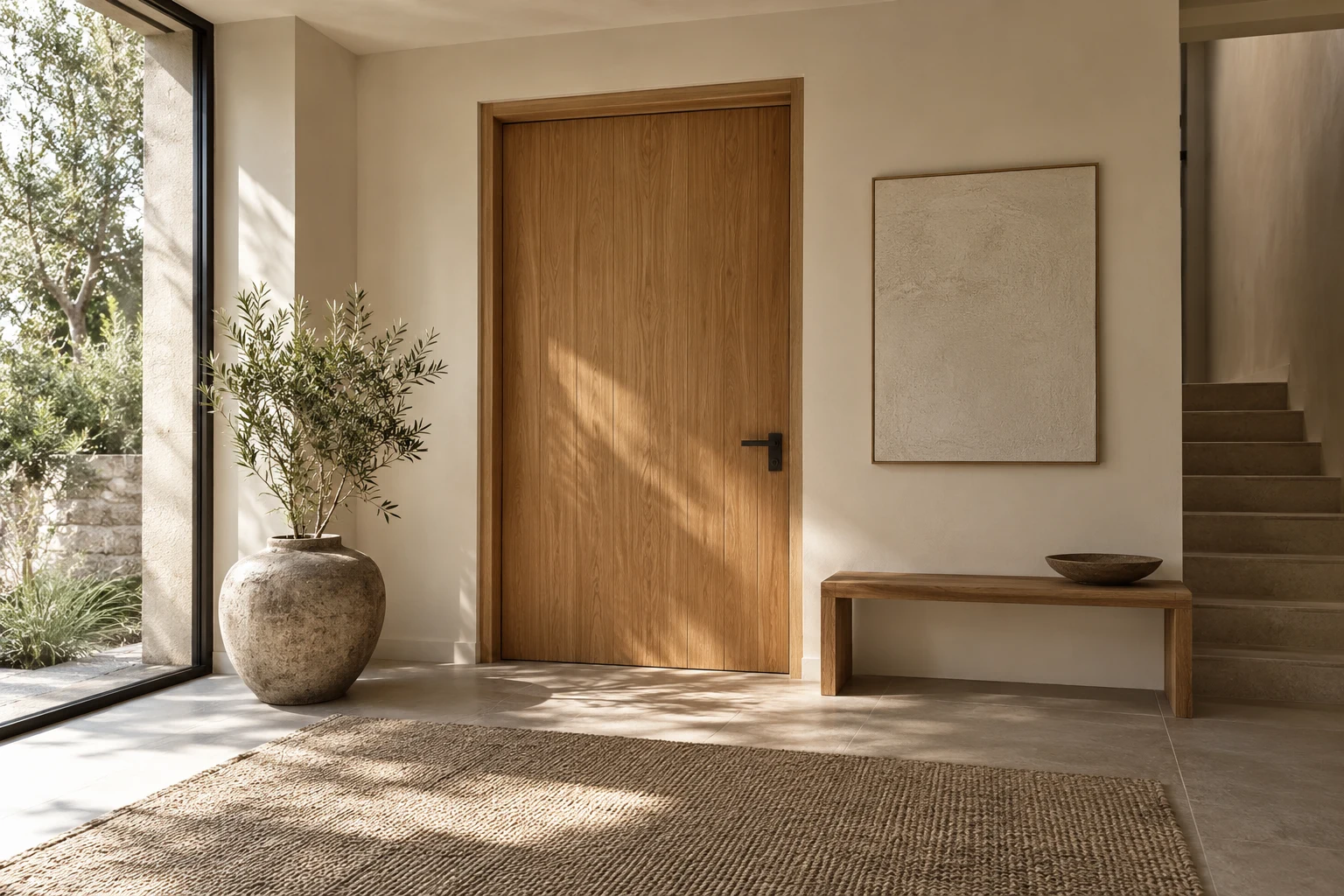
Architecture and setting
The townhouse door as a vertical composition
Materials and finishes
Warm neutrals for an entrance that is not beige by default
Form and proportion
5 articlesForm and proportion
A quieter kind of modern front door
Modern does not have to mean cold. Start with proportion, then decide which details deserve attention.
Read the articleForm and proportion
Choosing an entry door for a midcentury ranch
A low roofline asks for a different entrance than a tall, formal facade.
Read the articleForm and proportion
The Craftsman entrance: detail with a purpose
A convincing Craftsman doorway relies on rhythm and scale, not a checklist of decorative parts.
Read the articleForm and proportion
A fresh front door for a traditional brick house
Updating a familiar facade is often a question of editing rather than starting over.
Read the articleForm and proportion
Coastal style without the beach-house clichés
Light, shelter and a restrained palette can suggest the coast without a nautical prop in sight.
Read the articleArchitecture and setting
5 articlesArchitecture and setting
The townhouse door as a vertical composition
On a narrow facade, small changes to the entrance can have an unusually large effect.
Read the articleArchitecture and setting
Modern farmhouse, with fewer borrowed details
A front door can complement a farmhouse-inspired home without turning into another decorative motif.
Read the articleArchitecture and setting
An entrance for a desert-modern home
In a spare landscape, shadow can be as important as the finish on the door.
Read the articleArchitecture and setting
Bridging old and new with a transitional door
When the house contains several architectural eras, the front door can act as a mediator.
Read the articleArchitecture and setting
What an arched opening asks of a new door
The curve may belong to the wall, the frame or the door itself. Those are different design problems.
Read the articleColour and contrast
5 articlesColour and contrast
Black front doors: getting the contrast right
Black is a strong choice, but the surrounding surfaces decide whether it feels elegant or heavy.
Read the articleColour and contrast
Why a white entry door is not always the quiet option
White can blend into a facade or become its brightest accent. The undertone makes the difference.
Read the articleColour and contrast
Wood-look finishes without pretending every material is wood
A warm grain can be a design choice in its own right, provided the product description stays honest.
Read the articleColour and contrast
Green doors that belong to the landscape
The most convincing green is often found just outside the sample book.
Read the articleColour and contrast
A blue front door with grown-up confidence
Think about depth and undertone before deciding how bold you want to be.
Read the articleMaterials and finishes
5 articlesMaterials and finishes
Warm neutrals for an entrance that is not beige by default
A neutral door can have character when its relationship to the wall is carefully chosen.
Read the articleMaterials and finishes
Matching a front door to red brick without matching the brick
Mortar, shadow and variation offer better clues than a single red paint chip.
Read the articleMaterials and finishes
Matte, satin or gloss: the finish is part of the design
Sheen changes how a door catches light, reveals detail and relates to its surroundings.
Read the articleMaterials and finishes
Mixing metal finishes at the front door
Coordination is useful. Perfect sameness is optional.
Read the articleMaterials and finishes
A two-tone entry door: different outside, different inside
The street and the hallway do not always need the same color.
Read the articleGlass and privacy
5 articlesGlass and privacy
Privacy glass after sunset: the test that matters
A beautiful glass sample in daylight tells only half the story.
Read the articleGlass and privacy
The small glass insert that changes a solid door
A little daylight can shift the character of an entire entrance.
Read the articleGlass and privacy
One sidelight or two? Designing the whole opening
Symmetry is only one way to make an entrance feel balanced.
Read the articleGlass and privacy
A transom window and the art of borrowing light
Sometimes the best place for extra glazing is above the door.
Read the articleGlass and privacy
Reeded glass: texture without visual clutter
Linear glass works best when the rest of the entrance gives it room.
Read the articleLight and the opening
5 articlesLight and the opening
Long pull handles: proportion before drama
An oversized handle needs a reason beyond looking impressive in a close-up.
Read the articleLight and the opening
House numbers that belong to the entrance
Small lettering can organize the facade—or quietly disappear when it is needed.
Read the articleLight and the opening
Pivot-door inspiration, with room for reality
The impressive photograph is only the beginning of the conversation.
Read the articleLight and the opening
Flush panels and the importance of the surrounding frame
The simpler the door, the more visible every junction becomes.
Read the articleLight and the opening
A closer look at the 2026 Shaker-and-glass direction
New product introductions offer ideas, not a rulebook for your house.
Read the articleA considered approach.
Thirty existing editorial articles with their original addresses and photograph credits retained. Generated cover illustrations are fictional; product details remain in the existing collection.