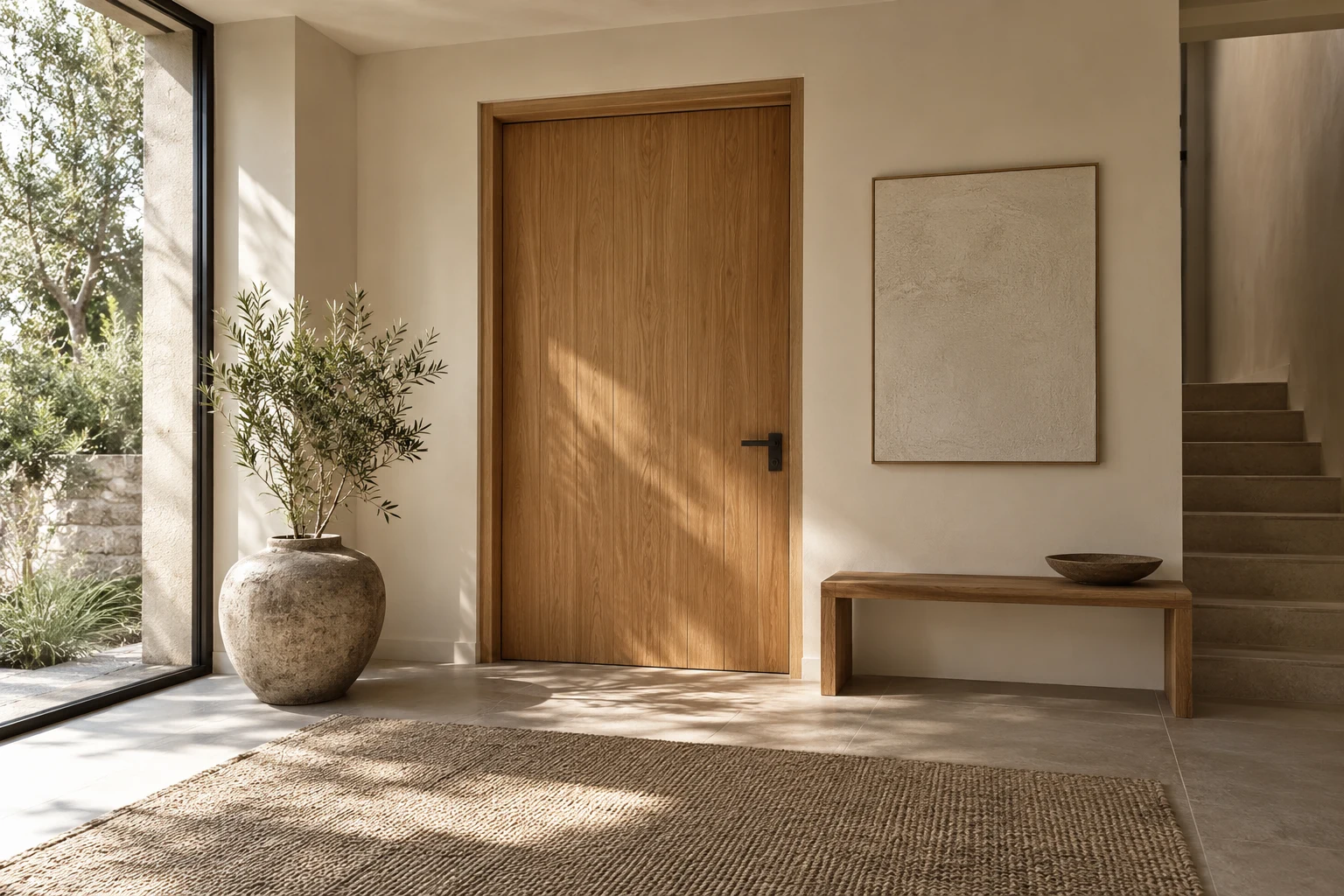

House numbers are often selected last, when the door, lighting and landscaping are already settled. Giving them a place earlier produces a more coherent entrance. It also avoids the awkward final choice between mounting them too close to a handle and hiding them behind a plant.
Study the approach from the street. The useful reading position is not necessarily directly in front of the door. A number beside a recessed entrance may look perfect in a photograph yet be invisible from the road. Contrast with the background matters just as much as the typeface.
Use the architecture to guide alignment. Numbers can sit along a masonry joint or share a vertical line with a light fixture. They do not have to copy the door hardware exactly. A simple, legible design usually leaves more room for the door to be the focal point.
Check local addressing requirements before choosing size or placement, and view a temporary paper layout after dark. If the wall finish or insulation system requires special fixings, ask for installation advice. Good typography should not come at the expense of a weather-tight facade.
Photograph credit & license
Yellow door, Volt House, Raphoe - geograph.org.uk - 7767171.jpg by Kenneth Allen. CC BY-SA 2.0. Displayed with responsive cropping; original downloaded image retained.
Yellow door, Volt House, Raphoe by Kenneth Allen
Photographs are drawn from an international architectural reference collection. Their use does not imply a Side Door installation or endorsement by the photographer.