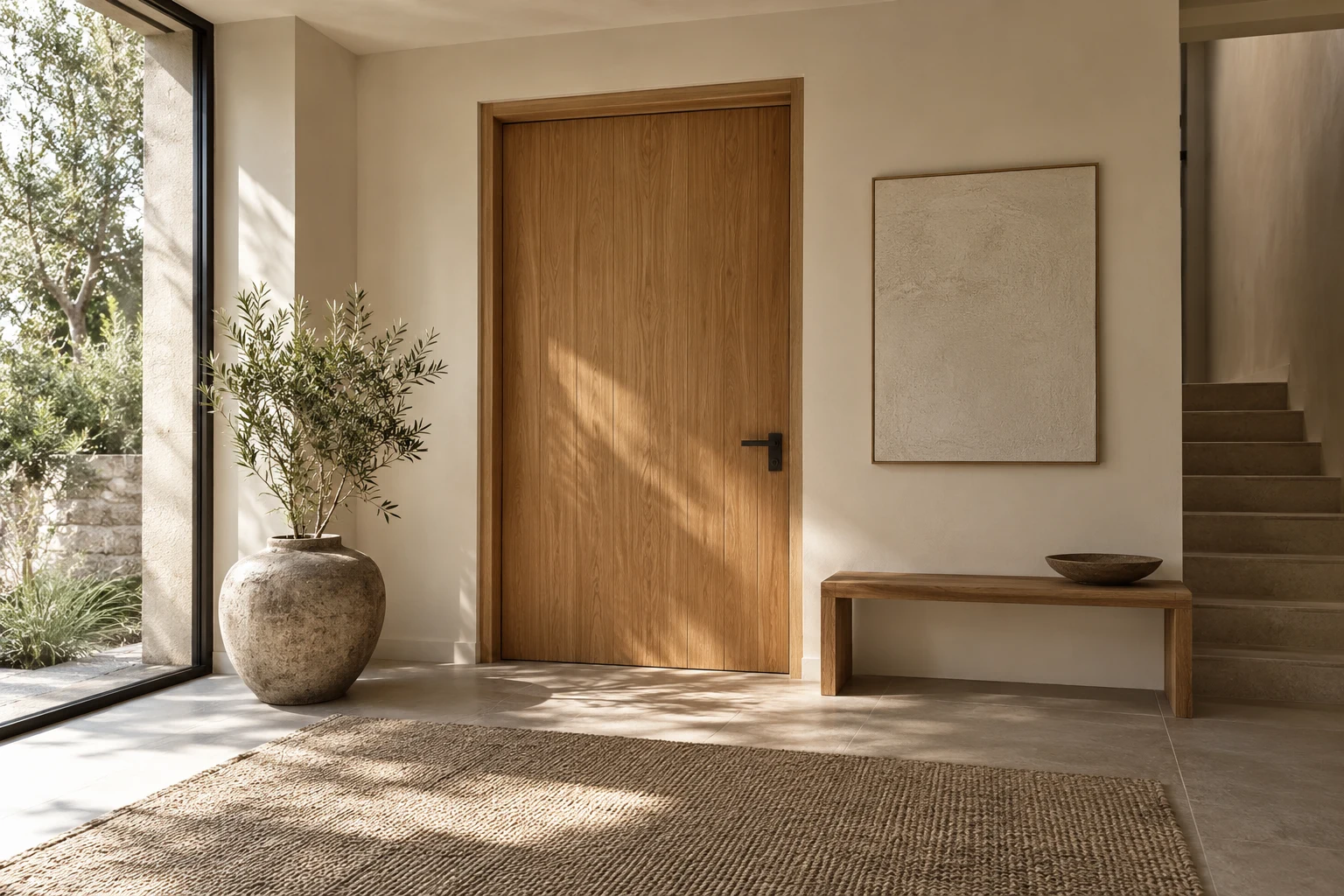

A flush panel removes the familiar hierarchy of raised borders and inset shapes. That leaves the perimeter doing more of the visual work. Frame thickness, shadow gaps and the meeting point with the wall become part of the design rather than background details.
Look beyond the product photograph. How will the proposed frame meet your existing brick, siding or stone? A clean panel surrounded by an unexpectedly broad cover trim can feel very different from the nearly frameless reference that first caught your attention.
Request a drawing that includes the full opening, not just the moving leaf. Ask which visible dimensions are fixed by the system and which can change. It is easier to reconcile those facts with your expectations before choosing a finish.
Simplicity does not require every surface to be perfectly flat and identical. A modest reveal can give the door a clear boundary and make the transition to an older wall more convincing. The goal is a deliberate junction, not an imaginary disappearance of all the components a working exterior door needs.
Photograph credit & license
Thatched cottage at Knarr Farm, Thorney Toll - The back door - geograph.org.uk - 4654348.jpg by Richard Humphrey. CC BY-SA 2.0. Displayed with responsive cropping; original downloaded image retained.
Thatched cottage at Knarr Farm, Thorney Toll - The back door by Richard Humphrey
Photographs are drawn from an international architectural reference collection. Their use does not imply a Side Door installation or endorsement by the photographer.